

From Machine Learning pipelines to LLM assistants, RAG and agentic systems.
Level: Beginner to intermediate Reading time: 20 min1. Main areas of artificial intelligence
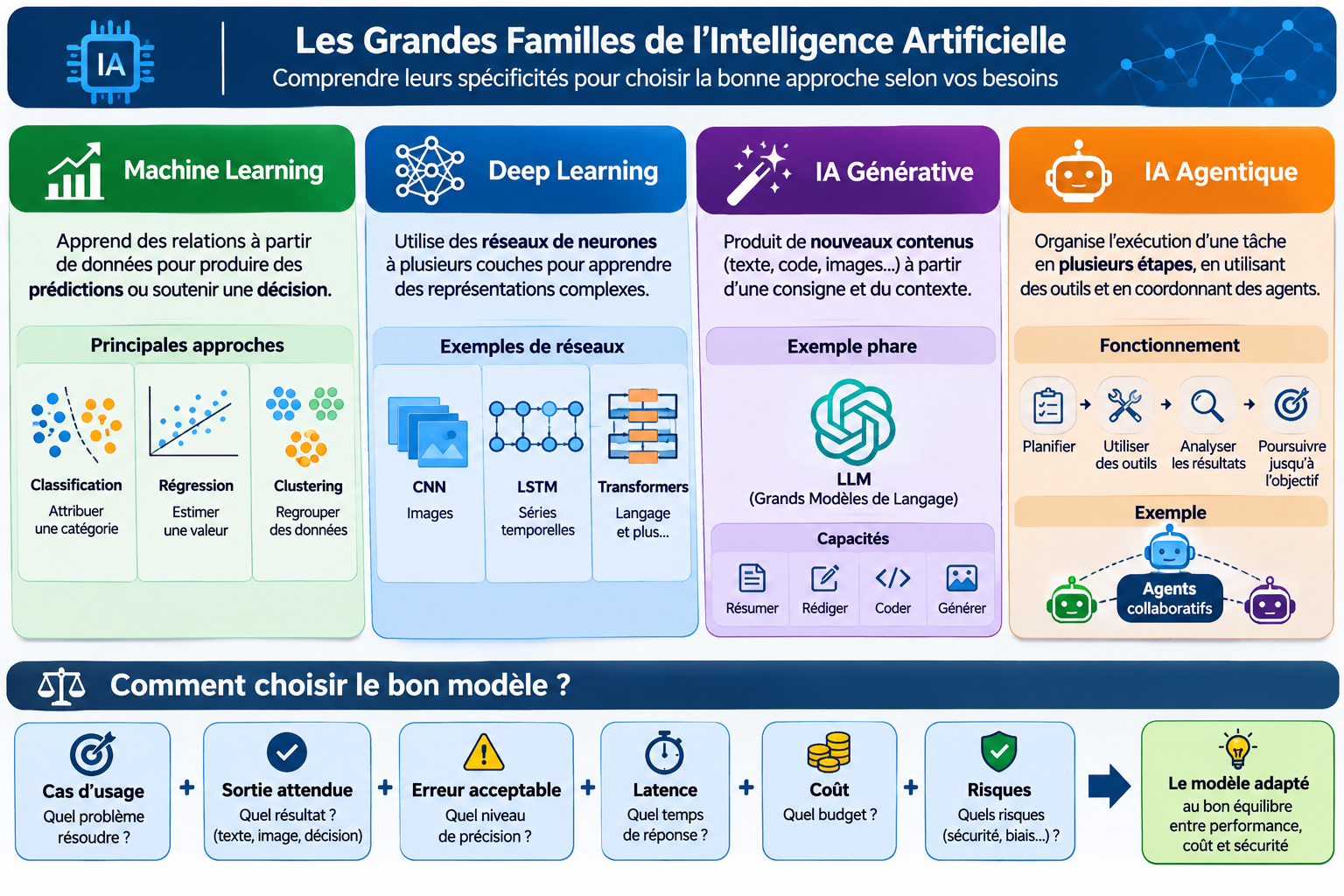
Machine Learning learns patterns from data to make predictions or support decisions. It includes classification, which assigns a category; regression, which estimates a value; and clustering, which groups similar observations. Read the guide to core algorithms.
Deep Learning uses multi-layer neural networks to learn complex representations. Convolutional networks (CNNs) are common for images, recurrent networks such as LSTMs for sequences, and Transformers for language and other sequential tasks. Explore Deep Learning, neural networks and LLMs.
Generative AI creates new content—such as text, code or images—from a prompt and context. Large language models (LLMs) are one example: they generate text, summarize, rephrase and answer questions.
Agentic AI organizes a task into several steps. An agent can plan, use tools or APIs, examine their results and continue towards a goal. Multiple agents can also coordinate specialized roles within one system. Explore the agentic AI reference architecture.
Choose a model only after defining the use case, expected output, acceptable error, latency, cost and risks.
2. AI Architecture and Machine Learning
- AI Enterprise Architecture Framework
- Reference Architecture for Agentic AI Systems
- Case study: C4 architecture for a credit agent
- Machine Learning: Core Algorithms
- Deep Learning: Neural Networks and LLMs
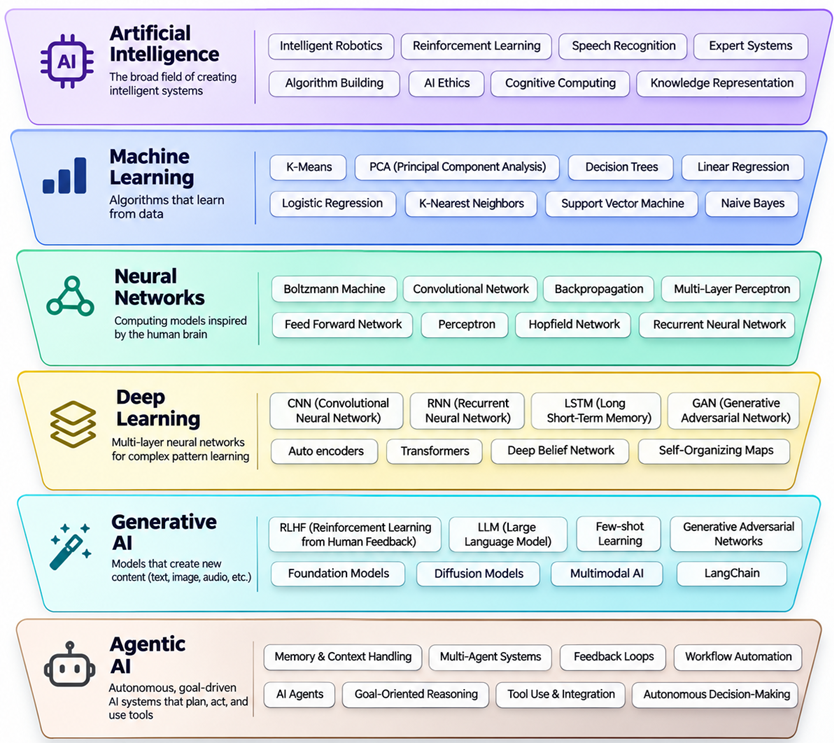
From AI foundations to agentic systems
This diagram places the main AI domains in context, from Machine Learning and neural networks through Deep Learning and generative AI to agentic systems.
Next steps: Apply the concepts to a real case, document your decisions, and compare functional, technical, operational and economic trade-offs.
← Back to home